Description
Understand the Mineral Composition, Crystal Structure and Particle Characteristics of Your Material
Need to verify the composition and characteristics of quartz, silica sand, calcium carbonate or another mineral filler?
Our Silica / Quartz / Mineral Analysis service helps businesses investigate the mineral composition, crystalline phases, elemental composition, particle size and particle morphology of mineral-based materials.
This service is particularly useful when you need to understand:
- What mineral phases are present?
- Is the material actually quartz or another silica-containing mineral?
- What crystalline form of quartz is present?
- What is the approximate mineral composition?
- Are there other minerals or inorganic impurities?
- What is the particle size distribution?
- Are the particles angular, rounded, irregular or agglomerated?
- Are differences between two mineral materials caused by composition, particle size or morphology?
Tell us what material you have and what you need to find out using the form above. We will review your requirements and recommend the most appropriate analytical testing.
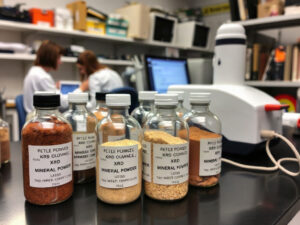
What Can We Help Determine?
Mineral materials can look very similar while having significantly different composition, crystal structure, particle size and morphology.
Our analysis can help investigate several important characteristics.
Mineral & Crystal Phase Identification
XRD can be used to identify crystalline mineral phases present in the sample.
For silica- and quartz-containing materials, this may help investigate whether the material contains:
- Quartz
- Other crystalline silica phases
- Calcium carbonate minerals
- Other silicate minerals
- Feldspar
- Clay minerals
- Other crystalline mineral phases
Where applicable, XRD can also help distinguish different crystalline phases of the same mineral system.
Mineral Composition & Elemental Chemistry
XRF can provide information about the major elemental composition of inorganic materials.
Depending on the material, this may help investigate elements such as:
- Silicon (Si)
- Calcium (Ca)
- Aluminium (Al)
- Iron (Fe)
- Magnesium (Mg)
- Potassium (K)
- Sodium (Na)
- Titanium (Ti)
- Other relevant inorganic elements
This can be useful for assessing whether a material is consistent with its expected mineral composition and for identifying significant inorganic components.
Particle Size Distribution
PSD analysis can determine the particle size distribution of the material, including:
- D10
- D50
- D90
- Particle size distribution curve
- Fine and coarse fractions
Particle size can have a major effect on the processing and performance of mineral fillers.
For example, differences in particle size may influence:
- Mixing
- Dispersion
- Packing density
- Surface finish
- Flow characteristics
- Resin demand
- Mechanical properties
- Workability
Particle Morphology & Agglomeration
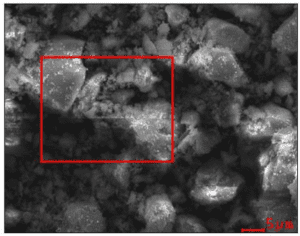
SEM can provide high-resolution images of the particles and help investigate their physical morphology.
The analysis may examine whether particles are:
- Angular
- Rounded
- Irregular
- Plate-like
- Blocky
- Fibrous
- Fine or coarse
- Agglomerated
Particle morphology can be particularly important when comparing different mineral suppliers or investigating why two materials with similar chemical composition behave differently.
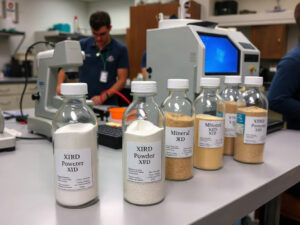
Analytical Techniques
XRD – Mineral & Crystal Phase Analysis
X-ray Diffraction (XRD) is one of the key techniques for investigating crystalline mineral phases.
XRD can help determine:
- Which crystalline phases are present
- Whether quartz is present
- The types of crystalline minerals present
- Differences between mineral samples
- Changes in crystalline composition between batches
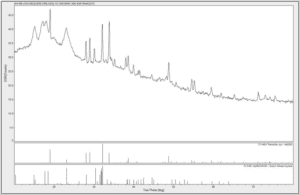
For quartz-containing materials, XRD can be particularly useful when the question concerns mineral phase or crystalline structure rather than simply elemental silicon content.
XRF – Elemental Composition
X-ray Fluorescence (XRF) is used to investigate the elemental composition of inorganic materials.
It can help assess:
- Major elemental composition
- Mineral-related elements
- Inorganic impurities
- Differences between mineral suppliers
- Batch-to-batch elemental variation
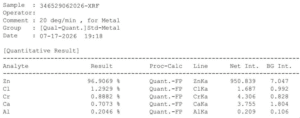
XRF is complementary to XRD: XRD investigates crystalline phases, while XRF investigates elemental composition.
PSD – Particle Size Distribution
Particle Size Distribution analysis provides quantitative information about the size distribution of particles.
Typical results may include:
- D10
- D50
- D90
- Particle size distribution
- Comparison between samples
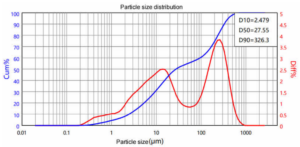
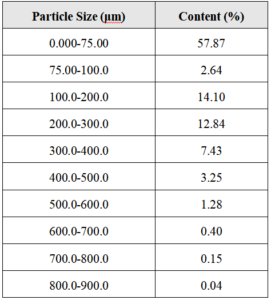
This can help determine whether a material is significantly finer or coarser than another material.
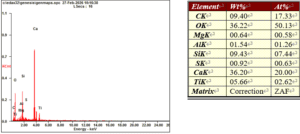
SEM/EDS – Particle Morphology & Elemental Information
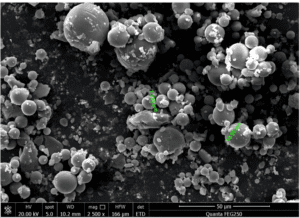
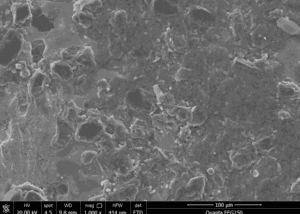
SEM provides high-resolution images of individual particles and their morphology.
EDS provides elemental information from selected areas or particles.
Together, SEM/EDS can help investigate:
- Particle shape
- Surface morphology
- Agglomeration
- Different particle populations
- Local elemental differences
- Visible foreign particles or inclusions
Why XRD and XRF Should Often Be Used Together
XRD and XRF provide different types of information.
For example, a material may contain a high proportion of silicon, but elemental silicon alone does not tell you exactly which mineral phases are present.
XRF can help answer:
What elements are present and in what approximate proportions?
XRD can help answer:
What crystalline mineral phases are present?
Using the two techniques together can therefore provide a more complete understanding of a mineral material.
Why Particle Size and Morphology Matter
Two mineral powders can have similar chemical composition but behave differently because their particle characteristics are different.
For example, two silica sands may both contain predominantly silica, but one may have:
- A larger D50
- More coarse particles
- More angular particles
- Less agglomeration
while the other may contain:
- Finer particles
- A different particle size distribution
- More irregular morphology
- Greater agglomeration
These differences may affect how the materials perform in coatings, resin systems, microcement and other construction applications.
Typical Materials We Analyse
This service is suitable for a range of mineral-based materials, including:
- Quartz
- Silica sand
- Silica-containing mineral materials
- Calcium carbonate (CaCO₃)
- Mineral fillers
- Stone powders
- Construction mineral powders
- Ceramic raw materials
- Industrial mineral powders
- Inorganic fillers
- Other mineral-based raw materials
If you are unsure what the material contains, you can provide the supplier’s description or specification and explain what you need to verify.
Typical Applications
Microcement
Investigate the mineral composition, particle size and morphology of powders used in microcement systems.
This can help when comparing:
- Different suppliers
- Different grades
- Original and replacement materials
- Normal and problematic batches
Concrete & Construction Materials
Characterise mineral fillers, sands and other inorganic materials used in construction products.
Resin Flooring
Investigate mineral fillers and aggregates used in resin flooring systems and assess differences between materials.
Mineral & Raw Material Suppliers
Verify the composition and characteristics of mineral materials supplied by different manufacturers or suppliers.
Manufacturing Troubleshooting
Investigate whether differences in mineral composition, particle size or morphology may be contributing to changes in processing or product performance.
Example: Comparing Two Silica Materials
A manufacturer uses a silica-based mineral material in a resin flooring or microcement product.
A replacement supplier provides a material that appears visually similar, but the finished product behaves differently during mixing and application.
The manufacturer wants to understand why.
A suitable analytical program may include:
XRD
to investigate mineral and crystalline phases,
XRF
to compare elemental composition,
PSD
to compare D10, D50 and D90,
and SEM/EDS
to investigate particle morphology, agglomeration and local elemental differences.
The combined results can provide a much clearer picture of how the two mineral materials differ.
One Sample Does Not Always Need Every Test
Not every mineral sample requires XRD, XRF, PSD and SEM/EDS.
The appropriate analytical program depends on:
- Material type
- Supplier specification
- Expected mineral composition
- Particle size
- Application
- What you need to find out
- Whether a reference sample is available
For example:
“Is this material quartz?”
may primarily require XRD.
“Why does this silica sand perform differently from our previous supplier?”
may require XRD + XRF + PSD + SEM/EDS.
“What is the particle size and morphology of this mineral filler?”
may primarily require PSD + SEM/EDS.
We select the analytical program according to your actual question rather than automatically applying every available test.
What You Receive
Depending on the selected testing program, the final report may include:
- Sample identification
- XRD results and mineral phase interpretation
- XRF elemental composition
- PSD results including D10, D50 and D90
- Particle size distribution data
- SEM images
- SEM morphology observations
- EDS elemental information
- Comparison with a reference or alternative sample, where applicable
- Identification of significant differences
- Technical interpretation of the results
The objective is to help you understand what the mineral material contains, how its particles are structured, and how it differs from another material where comparison is required.
Price & Turnaround
From $895 AUD + GST
Typical project range:
$895–$1,695 AUD + GST
Typical turnaround:
20–30 business days
The final price depends on:
- Number of samples
- Required analytical techniques
- Sample characteristics
- Level of comparison required
- Additional testing requirements
We will confirm the recommended analytical program and quotation before testing begins.
Our Process
1. Tell Us About Your Material
Provide information about:
- Material type
- Supplier description
- Intended application
- Sample quantity
- What you need to determine
2. We Review Your Requirements
We assess the material and determine which analytical techniques are most appropriate.
3. Receive a Testing Recommendation
We recommend a practical testing program based on your objectives.
4. Send Your Sample
Once the testing program is confirmed, send the required sample to us.
5. Laboratory Analysis
The selected analytical techniques are performed to investigate mineral composition, crystal phases, particle size and morphology.
6. Receive Your Report
You receive the analytical results together with technical observations and interpretation.
Who Is This Service For?
This service is particularly useful for:
- Microcement manufacturers
- Concrete manufacturers
- Resin flooring manufacturers
- Construction material manufacturers
- Mineral suppliers
- Chemical manufacturers
- Ceramic manufacturers
- Raw material importers
- Australian SMEs
- R&D and product development teams
Why Choose Labsure?
Multi-Parameter Mineral Characterisation
We can combine XRD, XRF, PSD and SEM/EDS to investigate different aspects of the same material.
Practical Testing
We focus on the specific question you need answered rather than automatically applying every available analytical technique.
Compare Different Materials
Where required, we can compare different suppliers, batches, grades or reference materials.
Suitable for Australian Businesses
We provide practical analytical support for Australian manufacturers, importers, suppliers and product developers.
Important Information
XRD, XRF, PSD and SEM/EDS provide different types of information and should be interpreted together where appropriate.
XRD identifies crystalline phases, while XRF provides elemental composition. These results should not be treated as interchangeable.
Particle size results depend on the analytical method and measurement conditions. SEM images provide representative observations of particle morphology and do not necessarily represent the entire sample population.
The final analytical program will be selected according to the specific material and testing objectives.