Unknown Liquid Analysis
Not sure what your liquid sample contains?
Our Unknown Liquid Analysis service helps identify and characterise unidentified liquids, including cleaning products, solvents, coatings, adhesives, resins and other industrial chemicals.
Tell us about your sample and what you need to find out using the form above. We will review your requirements and recommend the most appropriate analytical testing.
Description
Identify Unknown Liquids, Chemicals, Solvents & Industrial Formulations
Have you received a liquid from a supplier but are not sure exactly what it contains?
Are two liquids supplied under the same product name performing differently?
Do you need to identify an unknown chemical, solvent, cleaning product, coating, adhesive, resin or contaminant?
Labsure provides independent unknown liquid analysis and chemical characterisation for Australian businesses.
We combine analytical techniques such as FTIR, GC-MS, HS-GC-MS, HPLC, LC-MS/MS, IC and ICP-OES to investigate the chemical composition, organic compounds, ions, elemental content and other characteristics of your sample.
From $795 AUD + GST
Typical turnaround: 20–30 business days
You don’t need to know which test you need.
Tell us what you are trying to find out, and our technical team will recommend an appropriate analytical program.
What Can We Help You Find Out?
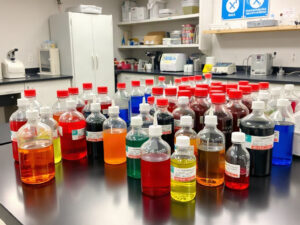
An unknown liquid may contain multiple organic and inorganic components, solvents, additives, salts, metals or other substances that cannot be identified by appearance alone.
Our analysis can help answer questions such as:
What is this liquid?
FTIR can provide a chemical fingerprint and help identify or screen many organic materials, polymers, resins, adhesives, coatings and other chemical materials.
What organic compounds are present?
GC-MS, HS-GC-MS, HPLC or LC-MS/MS may be considered to investigate organic compounds, solvents, additives and other components depending on the sample.
Are volatile solvents present?
HS-GC-MS can be considered for suitable liquid samples where volatile or semi-volatile organic compounds need to be investigated.
What ions are present?
Ion Chromatography (IC) can help investigate relevant anions and cations in suitable aqueous or liquid samples.
What elements are present?
ICP-OES can provide elemental composition information for suitable samples and may help investigate metals and other detectable elements.
How does this liquid compare with another product?
Comparative analysis can be used to investigate whether two liquids have similar or different chemical profiles.
What Can We Learn From Your Liquid?
01 — FTIR
What type of chemical or material is this?
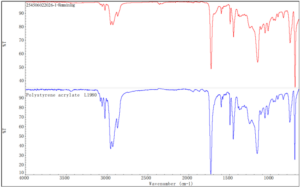
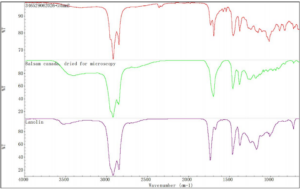
FTIR spectroscopy provides a chemical “fingerprint” based on infrared absorption.
It can be useful for screening and identifying many:
- Organic materials
- Polymers
- Resins
- Adhesives
- Coatings
- Solvents
- Cleaning products
- Organic additives
For suitable liquid samples, FTIR may help determine whether an unknown material is consistent with a particular chemical or material type.
Why does it matter?
FTIR can provide a rapid initial indication of the chemical nature of an unknown liquid and help determine whether additional analytical techniques may be required.
02 — GC-MS / HS-GC-MS
What organic compounds or volatile chemicals are present?
Gas Chromatography–Mass Spectrometry (GC-MS) can separate and identify suitable volatile and semi-volatile organic compounds.
Headspace GC-MS (HS-GC-MS) can be particularly useful for investigating volatile components without directly injecting the liquid sample into the instrument.
Results may help you investigate:
- Organic solvents
- Volatile compounds
- Semi-volatile compounds
- Cleaning chemical components
- Fragrance or volatile additives
- Unknown organic compounds
- Differences between liquid samples
Example:
A cleaning product may be supplied with a general product description, but its actual solvent or volatile organic composition may be unknown.
GC-MS or HS-GC-MS may help identify the compounds responsible for part of the product’s composition.
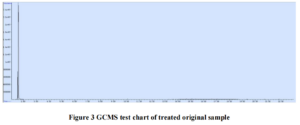
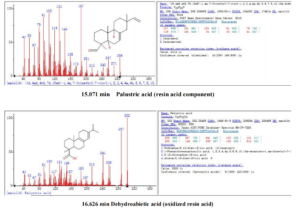
GC-MS is particularly useful when an unknown liquid may contain volatile or semi-volatile organic compounds.
03 — HPLC / LC-MS/MS
What non-volatile organic compounds may be present?
High-Performance Liquid Chromatography (HPLC) and Liquid Chromatography–Mass Spectrometry (LC-MS/MS) can be considered for suitable liquid samples containing compounds that are not suitable for GC-MS analysis.
Depending on the sample, these techniques may help investigate:
- Non-volatile organic compounds
- Organic additives
- Surfactants
- Formulation components
- Specialty chemicals
- Degradation products
- Other complex organic components
Example applications
Cleaning products
Surfactants · additives · organic components
Industrial chemicals
Specialty additives · formulation components
Coatings and adhesives
Resins · additives · organic components
HPLC
LC-MS
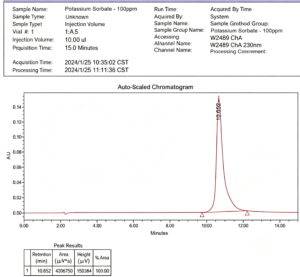
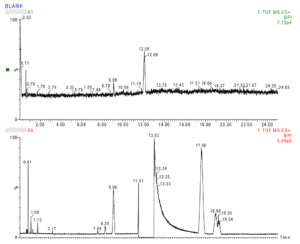
HPLC or LC-MS/MS can be particularly useful when the compounds of interest are non-volatile, thermally unstable or otherwise unsuitable for GC-MS.
04 — IC
What ions are present?
Ion Chromatography (IC) can be used for suitable liquid samples to investigate ionic components.
Depending on the sample, analysis may provide information about relevant:
Chloride · Fluoride · Bromide · Nitrate · Sulfate
and other detectable ions.
Why is this useful?
IC can help with:
- Raw material verification
- Cleaning product investigation
- Water-based formulation analysis
- Supplier comparison
- Investigation of unexpected ionic components
- Product troubleshooting
Example
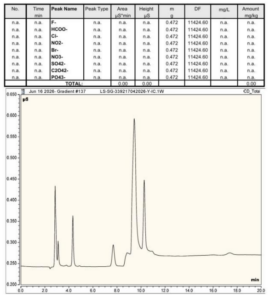
Two cleaning products may have similar appearance and performance but contain different ionic compositions.
IC can help investigate these differences.
05 — ICP-OES
What elements are present?
ICP-OES can provide elemental composition information for suitable liquid samples.
Depending on the sample and analytical requirements, analysis may provide information about elements such as:
Na · K · Ca · Mg · Fe · Al · Cu · Zn
and other detectable elements.
Why is this useful?
ICP-OES can help with:
- Raw material verification
- Elemental characterisation
- Supplier comparison
- Investigation of unexpected metals
- Product contamination investigations
- Quality control investigations
Example
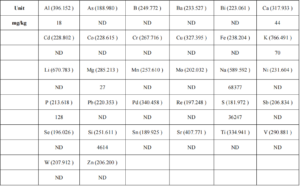
A liquid product may contain an unexpected metallic or inorganic component.
ICP-OES can help determine which detectable elements are present and support further investigation.
06 — Comparative Liquid Analysis
Are two liquids actually the same or different?
Comparative analysis can be useful when two products appear similar but perform differently, or when you need to investigate whether a supplier’s material is consistent with a reference sample.
Depending on the samples, comparison may include:
- FTIR
- GC-MS / HS-GC-MS
- HPLC / LC-MS/MS
- IC
- ICP-OES
- Other appropriate analytical techniques
Example
Two cleaning products may both be described as the same type of industrial cleaner, but one may perform differently during application.
Comparative analytical testing can help identify chemical differences that may explain the different performance.
What Does the Final Result Look Like?
Your final analytical report may include, where applicable:
Sample Identification
Sample description, sample reference and analytical scope.
Analytical Results
Depending on the selected analytical program:
- FTIR spectrum
- GC-MS chromatogram and identified compounds
- HS-GC-MS results
- HPLC chromatogram
- LC-MS/MS results
- IC results
- ICP-OES elemental results
- Other analytical data where appropriate
Technical Interpretation
We don’t simply provide instrument outputs.
Where the analytical data allows, Labsure can provide an interpretation of what the results indicate about the sample and how the findings relate to your stated analytical objective.
One Sample Does Not Always Need Every Test
This is important.
We do not automatically perform every analytical technique on every liquid.
The appropriate analytical methods depend on:
- The type of sample
- The information you need
- The suspected composition
- The sample quantity
- The complexity of the formulation
- Whether a reference or comparison sample is available
For example:
Unknown cleaning liquid
FTIR + GC-MS / HS-GC-MS + IC
may be appropriate.
Unknown solvent or industrial liquid
FTIR + GC-MS / HS-GC-MS
may provide useful information.
Unknown water-based formulation
FTIR + IC + ICP-OES
may be considered depending on the analytical objective.
Complex unknown formulation
Additional techniques such as GC-MS, HPLC, LC-MS/MS, IC or ICP-OES may be considered where appropriate.
You don’t need to decide which instrument to use. Labsure can help determine the analytical approach based on the question you need answered.
Who Is This Service For?
Our Unknown Liquid Analysis service is suitable for Australian businesses working with:
- Industrial and commercial cleaning products
- Solvents and chemical solutions
- Paints and coatings
- Adhesives and sealants
- Resins and polymers
- Industrial chemicals
- Process chemicals
- Maintenance chemicals
- Raw materials
- Imported chemical products
- Unknown contaminants
- Manufacturing materials
It can be particularly useful for businesses that need to verify imported raw materials, investigate product problems, compare suppliers or understand an unknown liquid before further formulation work.
Typical Questions We Help Answer
“My supplier says this is a particular chemical. Can you verify it?”
We can recommend an analytical approach based on the sample and the level of verification required.
“Two suppliers sell me the same liquid, but they behave differently. Why?”
Comparative analysis using appropriate techniques such as FTIR, GC-MS, HPLC, IC or ICP-OES may help identify chemical differences.
“There is an unexpected component in my liquid product. What is it?”
GC-MS, HPLC, LC-MS/MS, IC, ICP-OES or other techniques may be considered depending on the component and sample.
“I have an old liquid but no specification. Can you identify it?”
Yes. We can review the sample and determine an appropriate analytical program.
“I don’t know what test I need.”
That’s fine.
Simply tell us what you are trying to find out. We can review the information and recommend the appropriate analytical approach.
How Our Unknown Liquid Analysis Works
1. Tell us about your sample
Submit your sample details, photos, existing specifications, SDS, COA or other available information.
2. We review your analytical objective
We focus on what you need to know, rather than simply selecting a standard test.
3. We recommend the analytical program
We select appropriate techniques based on the sample and your objective.
4. Receive a fixed quotation
You will receive a clear price and estimated turnaround before proceeding.
5. Send your sample
Once you approve the quotation, we provide sample submission instructions.
6. Analysis and technical report
Your sample is analysed using the agreed analytical program, followed by technical review and reporting.
Why Choose Labsure?
Problem-focused analysis
We start with your question, not the instrument.
Multiple analytical techniques
Our analytical capability includes FTIR, NMR, HPLC, GC-MS, LC-MS/MS, XRD, XRF, SEM/EDS, PSD, TGA, IC and ICP-OES, allowing different techniques to be considered for different sample types.
Suitable for Australian SMEs
You don’t need to maintain your own analytical laboratory or know which analytical technique to order.
Fixed quotation before testing
We review your requirements and confirm the analytical scope and price before proceeding.
Independent analytical investigation
Useful for raw material verification, product comparison, formulation investigation and chemical troubleshooting.
Pricing
Unknown Liquid Analysis — From $795 AUD + GST
The final price depends on:
- Sample type
- Analytical objective
- Number and complexity of analytical techniques
- Sample preparation requirements
- Whether comparison samples are required
Typical turnaround: 20–30 business days.
For complex investigations, a longer turnaround may apply.