Description
Understand What May Be Inside a Competitor’s Product
Want to understand what chemical components and material characteristics may be used in a competitor’s product?
Our Competitive Product Characterisation service helps manufacturers, product developers and formulators investigate the chemical and material characteristics of competitor products.
By combining complementary analytical techniques, we can investigate organic components, inorganic materials, thermal characteristics and other measurable properties of a reference product.
This service can help answer practical questions such as:
- What types of chemical components may be present?
- What solvents, resins, additives or other organic materials may be present?
- Does the product contain mineral or inorganic components?
- What are the major chemical differences between our product and the competitor’s product?
- Are there components that may be contributing to the competitor’s performance?
- Which parts of the competitor’s formulation may require further investigation?
- Can the analytical results provide a starting point for developing a similar or improved product?
Tell us about the competitor product and what you are trying to understand using the form above. We will review the sample and recommend the most appropriate analytical testing.
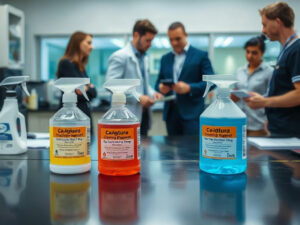
What Can We Help Determine?
A competitor product is usually a complex formulation rather than a single chemical.
Different analytical techniques provide information about different parts of the formulation.
Depending on the product, our characterisation program may investigate:
Organic Components
Investigate detectable organic components such as:
- Solvents
- Oils
- Resins
- Surfactants
- Plasticisers
- Fragrance components
- Organic additives
- Other detectable organic compounds
GC-MS, HS-GC-MS, HPLC or LC-MS/MS may be considered depending on the characteristics of the sample.
Chemical Functional Groups & Material Fingerprint
FTIR can provide an overall chemical fingerprint and help identify characteristic functional groups and major chemical classes.
This can help establish whether a competitor product contains materials such as:
- Polymer or resin systems
- Organic binders
- Certain surfactant-related materials
- Oils or other organic materials
- Other identifiable chemical classes
Inorganic & Mineral Components
For products containing powders, pigments, fillers, minerals or other inorganic materials, XRF and XRD may provide additional information.
This may help investigate:
- Mineral fillers
- Pigments
- Silica-containing materials
- Calcium carbonate
- Other inorganic components
- Crystalline mineral phases
- Elemental composition
Thermal Characteristics
TGA can provide information about the thermal behaviour and weight-loss profile of a material.
Depending on the sample, this may help investigate:
- Volatile content
- Moisture-related weight loss
- Organic content
- Decomposition behaviour
- Inorganic residue
- Differences between competitor and reference products
TGA is particularly useful when combined with other analytical techniques.
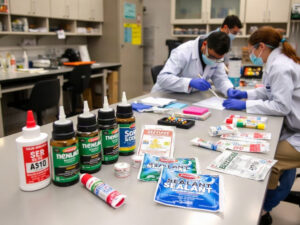
Analytical Techniques
FTIR – Chemical Fingerprint
FTIR provides a rapid chemical fingerprint of suitable materials.
It can help investigate:
- Functional groups
- Organic material classes
- Resins and polymers
- Oils
- Certain surfactant-related materials
- Overall chemical differences between samples
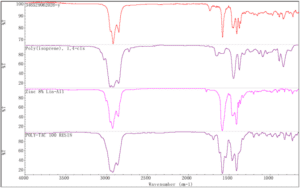
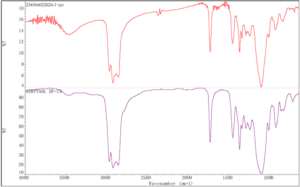
FTIR is often useful as an initial characterisation technique before more targeted analytical testing.
GC-MS / HS-GC-MS – Volatile & Semi-Volatile Components
GC-MS and HS-GC-MS can investigate suitable volatile and semi-volatile organic compounds.
They may help identify:
- Solvents
- Residual solvents
- Fragrance components
- Volatile additives
- Other detectable organic compounds
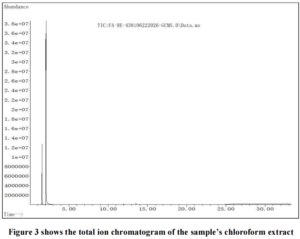
HS-GC-MS can be particularly useful for volatile components in suitable liquid products.
HPLC / LC-MS/MS – Non-Volatile Organic Components
Some formulation components are not suitable for GC analysis.
For suitable samples, HPLC or LC-MS/MS may be used to investigate:
- Non-volatile organic components
- Organic additives
- Higher molecular weight components
- Polar compounds
- Related compounds
- Components requiring liquid-phase separation
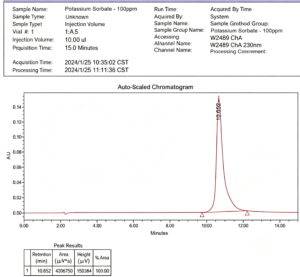
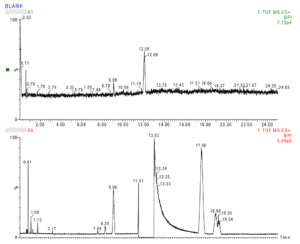
The exact method depends on the sample and analytical objective.
XRF – Elemental Composition
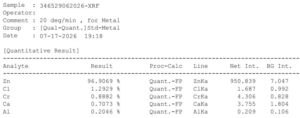
XRF can investigate the elemental composition of suitable solid and mineral-containing products.
It may help identify differences associated with:
- Mineral fillers
- Pigments
- Inorganic additives
- Metallic elements
- Mineral raw materials

XRD – Mineral & Crystal Phase Analysis
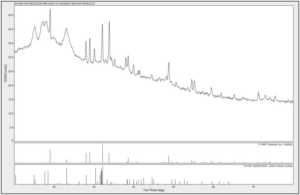
XRD can investigate crystalline mineral phases in suitable samples.
It may help determine whether a competitor product contains crystalline materials such as:
- Quartz
- Calcium carbonate minerals
- Silicate minerals
- Other crystalline inorganic phases
TGA – Thermal & Composition Information
TGA measures weight changes as a sample is heated under controlled conditions.
Depending on the formulation, it may provide information about:
- Volatile components
- Moisture
- Organic fraction
- Decomposition behaviour
- Inorganic residue
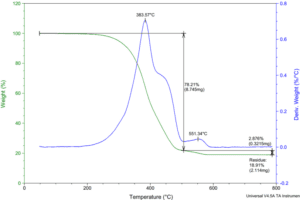
This can be particularly useful for comparing competitor products with your own formulation.
Why Multiple Analytical Techniques Are Used
No single analytical technique can normally reveal everything about a complex competitor formulation.
For example:
FTIR may indicate the presence of a particular chemical class.
GC-MS may identify specific volatile or semi-volatile organic compounds.
HPLC / LC-MS/MS may provide additional information about non-volatile organic components.
XRF may identify elemental differences associated with inorganic materials.
XRD may identify crystalline mineral phases.
TGA may provide information about volatile, organic and inorganic fractions.
By combining complementary techniques, we can build a more comprehensive analytical profile of the competitor product.
Competitive Product Characterisation vs Full Reverse Engineering
Competitive Product Characterisation is designed to investigate and characterise a competitor product.
It can provide valuable information about:
- Chemical components
- Material classes
- Organic and inorganic composition
- Mineral phases
- Thermal behaviour
- Major differences between products
However, analytical characterisation does not automatically produce an exact manufacturing formula.
If your objective is to develop a reproducible formulation that closely matches the competitor product, you may require a more comprehensive Chemical Reverse Engineering / Deformulation project.
Competitive Product Characterisation can therefore serve as an important first step in a larger product development or reverse engineering program.
Typical Products We Analyse
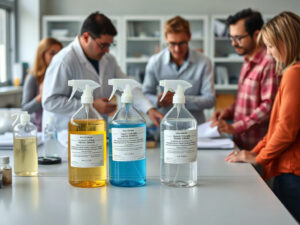
This service can be applied to a wide range of chemical and formulated products, including:
- Cleaning products
- Industrial cleaners
- Coatings
- Paints
- Adhesives
- Sealants
- Resins
- Industrial liquids
- Chemical formulations
- Powders
- Mineral-containing products
- Construction materials
- Specialty chemical products
Typical Applications
Competitor Benchmarking
Investigate a competitor’s product to understand its measurable chemical and material characteristics.
New Product Development
Use analytical information from an existing market product as a starting point for developing a new or improved formulation.
Formulation Improvement
Compare your existing product with a competitor product to identify potentially significant chemical or material differences.
Product Performance Investigation
Investigate whether differences in composition may help explain why a competitor product performs differently.
Supplier & Raw Material Investigation
Characterise products or materials supplied by different manufacturers and identify significant chemical differences.
Example: Competitor Cleaning Product
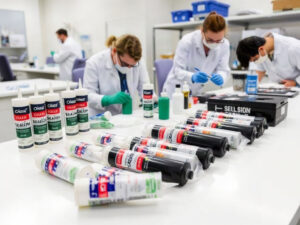
An Australian cleaning product manufacturer has a competitor product that performs significantly better on a particular type of industrial soil.
The manufacturer wants to understand what may be different about the competitor formulation.
A suitable analytical program may include:
FTIR
to investigate the overall organic chemical fingerprint,
GC-MS / HS-GC-MS
to investigate volatile and semi-volatile organic components,
and, depending on the sample,
HPLC / LC-MS/MS
to investigate additional non-volatile organic components.
If the product contains significant inorganic or mineral components, XRF / XRD may also be considered.
TGA may provide additional information about volatile, organic and inorganic fractions.
The resulting analytical profile can help the manufacturer identify areas of the competitor formulation that may warrant further investigation during product development.
Example: Competitor Coating or Adhesive
A manufacturer has developed a coating or adhesive but believes a competitor product has better performance.
The two products may appear visually similar but behave differently during application and testing.
A comparative characterisation program could investigate:
- Organic chemical fingerprint
- Solvent profile
- Resin or binder characteristics
- Inorganic fillers
- Mineral phases
- Thermal behaviour
The results can then be used to guide further formulation development and optimisation.
One Sample Does Not Always Need Every Test
Not every competitor product requires FTIR, GC-MS, HPLC, XRF, XRD and TGA.
The analytical program depends on:
- Product type
- Physical form
- Expected formulation
- Organic vs inorganic composition
- Volatility
- Complexity
- What you need to understand
- Whether your own product is also available for comparison
For example:
“What organic solvents are being used?”
may require FTIR + GC-MS / HS-GC-MS.
“What organic and inorganic materials may be present?”
may require a broader multi-technique program.
“Why is the competitor coating different from ours?”
may benefit from FTIR + GC-MS/HPLC + XRF/XRD + TGA.
We select the analytical program according to the actual product and your objectives rather than automatically applying every available test.
What You Receive
Depending on the selected analytical program, the final report may include:
- Sample identification
- Analytical methods used
- FTIR results and interpretation
- GC-MS / HS-GC-MS results
- HPLC / LC-MS/MS results where applicable
- Identified or tentatively identified organic components
- XRF elemental results where applicable
- XRD mineral phase results where applicable
- TGA results and thermal observations
- Analytical observations
- Comparison with your own product, where requested
- Identification of significant chemical or material differences
- Technical interpretation
- Recommendations for further investigation where appropriate
The objective is to provide a practical analytical characterisation profile that can support product development, benchmarking and further reverse engineering.
From Characterisation to Formulation Development
Competitive Product Characterisation can be used as the analytical starting point for a broader product development program.
For example:
Competitor Product
↓
Analytical Characterisation
↓
Identify Key Chemical & Material Characteristics
↓
Formulation Development
↓
Performance Testing & Optimisation
This approach can help reduce the uncertainty involved in developing a new product based only on trial and error.
Price & Turnaround
From $1,295 AUD + GST
Typical project range:
$1,295–$2,500+ AUD + GST
Typical turnaround:
20–35 business days
The final price depends on:
- Number of samples
- Product complexity
- Required analytical techniques
- Number of components requiring investigation
- Comparison requirements
- Additional testing requirements
- Level of technical interpretation required
More complex formulations may require additional analytical work beyond the standard project range.
We will confirm the recommended analytical program and quotation before testing begins.
Our Process
1. Tell Us About the Competitor Product
Provide information about:
- Product type
- Product application
- Supplier or manufacturer, if available
- SDS or product information, if available
- Sample quantity
- What you want to understand
2. We Review Your Requirements
We assess the product and determine which analytical techniques are most appropriate.
3. Receive a Testing Recommendation
We recommend a practical characterisation program based on the product and your objectives.
4. Send Your Sample
Once the testing program is confirmed, send the required sample to us.
5. Laboratory Analysis
The selected analytical techniques are performed to investigate the chemical and material characteristics of the competitor product.
6. Receive Your Report
You receive the analytical results together with relevant observations and technical interpretation.
Who Is This Service For?
This service is particularly useful for:
- Product development companies
- Chemical manufacturers
- Formulators
- Cleaning product manufacturers
- Coating manufacturers
- Adhesive manufacturers
- Resin manufacturers
- R&D companies
- Chemical businesses
- Australian SMEs
Why Choose Labsure?
Multi-Technique Characterisation
We can combine organic, inorganic and thermal analytical techniques to build a broader picture of a competitor product.
Product Development Focus
The objective is not simply to generate laboratory data, but to provide information that can support formulation development and benchmarking.
Flexible Analytical Programs
Testing is selected according to the product rather than applying the same test package to every sample.
Practical Technical Interpretation
We help translate analytical results into useful information about potential formulation and material differences.
Important Information
Competitive Product Characterisation provides analytical information about detectable components and measurable material characteristics.
The analytical results do not necessarily reveal the complete original manufacturing formula or exact concentration of every ingredient.
Some components may be difficult to identify because of:
- Complex formulations
- Overlapping analytical signals
- Low concentrations
- Similar chemical structures
- Lack of suitable reference standards
- Instrumental limitations
Where a compound cannot be confidently identified, it may be reported as a tentatively identified or unknown component based on the available analytical data.
If you require a more detailed formulation reconstruction, additional analytical and formulation development work may be required.
All analytical work should be used for legitimate product development, benchmarking, quality investigation and research purposes, with appropriate consideration of intellectual property, confidentiality and applicable laws.