Description
Identify and Measure Elements in Your Chemical Material
Do you need to know whether your material contains Cu, Fe, Zn, Pb, Ni, Cr or other elements?
Our Trace / Elemental Analysis service helps Australian businesses investigate the elemental composition of water, liquids, powders, minerals, chemical raw materials and other industrial materials.
This service can help answer practical questions such as:
- Which elements are present in the sample?
- Does the material contain Cu, Fe, Zn, Pb, Ni, Cr or other metals?
- What is the concentration of a particular element?
- Are there unexpected or potentially contaminating elements?
- Are two raw materials different in elemental composition?
- Does a mineral or powder contain specific metallic elements?
- Has elemental contamination occurred during manufacturing or processing?
Tell us what material you have and which elements you need to investigate using the form above. We will review your requirements and recommend the most appropriate analytical testing.
What Can We Help Determine?
Elemental analysis can provide information that cannot be obtained from techniques such as FTIR alone.
Depending on the sample and analytical program, we may investigate:
Major & Minor Elements
Determine which inorganic elements are present and, where the analytical method supports it, their concentrations.
Potential elements may include:
- Copper (Cu)
- Iron (Fe)
- Zinc (Zn)
- Lead (Pb)
- Nickel (Ni)
- Chromium (Cr)
- Calcium (Ca)
- Magnesium (Mg)
- Aluminium (Al)
- Sodium (Na)
- Potassium (K)
- Manganese (Mn)
- Titanium (Ti)
- Silicon (Si)
- Other relevant elements
The actual element list depends on the material and testing requirements.
Trace & Potentially Unwanted Elements
Elemental testing can also be used to investigate unexpected or unwanted elements in raw materials and finished products.
For example:
- Heavy metal contamination
- Metallic impurities
- Process-related contamination
- Raw material impurities
- Differences between suppliers
- Batch-to-batch elemental variation
Where low-level detection is required, the appropriate analytical method and sample preparation need to be considered carefully.
Analytical Techniques
ICP-OES – Quantitative Elemental Analysis
ICP-OES (Inductively Coupled Plasma Optical Emission Spectroscopy) is a key technique for determining the elemental composition of suitable liquid and digested solid samples.
It can be used to measure multiple elements in a single analytical program.
Depending on the sample and method, ICP-OES can investigate elements such as:
- Cu
- Fe
- Zn
- Pb
- Ni
- Cr
- Ca
- Mg
- Al
- Mn
- Na
- K
- Other relevant elements
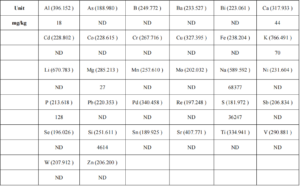
ICP-OES is particularly useful when you need quantitative elemental concentrations rather than simply knowing whether an element is present.
XRF – Rapid Elemental Screening
X-ray Fluorescence (XRF) is particularly useful for solid and mineral-based materials.
It can help investigate:
- Major elements
- Minor elements
- Inorganic composition
- Mineral-related elemental differences
- Supplier and batch variation
XRF can be especially useful for:
- Mineral powders
- Fillers
- Sands
- Ceramic materials
- Construction materials
- Solid raw materials
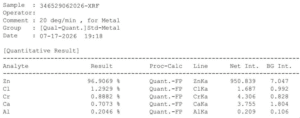
XRF and ICP-OES provide complementary information and are not always interchangeable.
SEM/EDS – Local Elemental Analysis
SEM/EDS combines high-resolution microscopy with elemental analysis.
It can help investigate:
- Which elements are present in individual particles
- Differences between particles
- Foreign particles or inclusions
- Surface contamination
- Local elemental composition
- Particle morphology together with elemental information
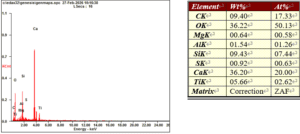
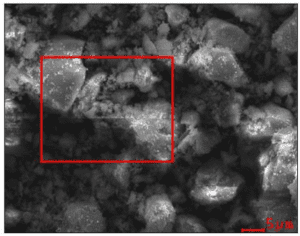
EDS is particularly useful when the question is not only “what elements are in the bulk sample?”, but also “which particles or areas contain those elements?”
IC – Ionic Species
For suitable aqueous samples, Ion Chromatography (IC) may be considered when the objective is to investigate specific ionic species.
Depending on the analytical program, IC can be useful for investigating ions such as:
- Chloride
- Fluoride
- Bromide
- Nitrate
- Sulfate
- Other suitable inorganic ions
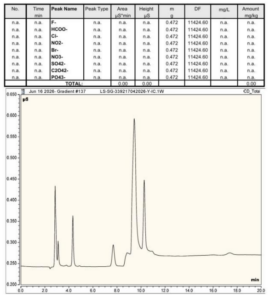
IC is therefore complementary to elemental analysis: it investigates specific ionic species rather than simply reporting total elemental concentrations.
ICP-OES vs XRF vs EDS
Different analytical techniques answer different questions.
ICP-OES
Best suited to:
How much of each selected element is present in the prepared sample?
Useful for quantitative elemental analysis of suitable liquids and digested materials.
XRF
Best suited to:
What elements are present in this solid or mineral material, and what is its overall elemental composition?
Useful for solid raw materials, powders and minerals.
SEM/EDS
Best suited to:
Where are these elements located, and which particles or areas contain them?
Useful when elemental information needs to be linked to particle morphology or specific features.
IC
Best suited to:
Which specific inorganic ions are present in a suitable aqueous sample?
Useful when ionic composition is the main question.
Elemental Analysis for Different Sample Types
Water & Aqueous Samples
Elemental analysis can help investigate dissolved or otherwise appropriately prepared elemental components in water and other aqueous samples.
Potential applications include:
- Raw water investigation
- Process water
- Industrial water
- Chemical solutions
- Manufacturing contamination
- Comparison between water samples
ICP-OES may be appropriate for elemental analysis, while IC may be considered for specific inorganic ions.
Liquid Chemicals
For suitable liquid chemical samples, ICP-OES can be used after appropriate sample preparation to investigate elemental composition.
This may help identify:
- Metallic contamination
- Raw material impurities
- Process-related elements
- Differences between batches
Powders & Mineral Materials
For powders, fillers and minerals, XRF and/or ICP-OES may be considered depending on the analytical objective.
SEM/EDS can provide additional information about individual particles and local elemental differences.
Why Elemental Analysis Is Useful
A chemical material may appear visually normal but still contain unexpected elemental components.
For example, two white powders may look identical, but elemental analysis could show significant differences in:
- Iron
- Aluminium
- Calcium
- Magnesium
- Titanium
- Other inorganic elements
These differences may help explain differences in:
- Colour
- Purity
- Product performance
- Processing behaviour
- Stability
- Compatibility
- Supplier consistency
Elemental analysis can therefore be a useful part of raw material verification and manufacturing troubleshooting.
Typical Materials We Analyse
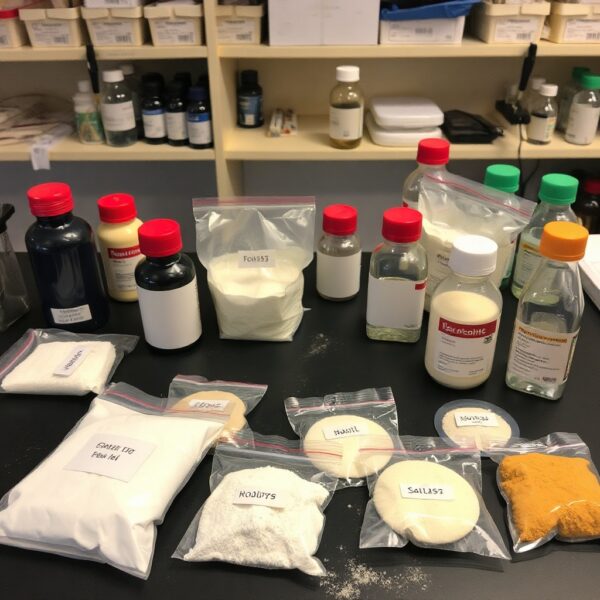
This service is suitable for a range of materials, including:
- Water
- Aqueous solutions
- Industrial liquids
- Chemical raw materials
- Powders
- Mineral powders
- Fillers
- Sands
- Ceramic materials
- Construction materials
- Inorganic materials
- Manufacturing raw materials
- Other suitable industrial samples
If you are unsure which analytical technique is appropriate, simply tell us what the material is and which elements you need to investigate.
Typical Applications
Chemical Manufacturing
Investigate elemental composition and potential contamination in chemical raw materials and manufacturing materials.
Mining & Minerals
Characterise mineral materials and investigate elemental composition and differences between samples.
Materials & Manufacturing
Investigate unexpected elemental components in powders, fillers, coatings and other industrial materials.
Environmental Investigation
Investigate elemental composition in suitable water, soil, mineral or industrial samples.
Raw Material Verification
Compare elemental composition between:
- Different suppliers
- Different batches
- Original and replacement materials
- Reference and unknown samples
Manufacturing Troubleshooting
Investigate whether unexpected elemental contamination may be contributing to changes in product quality or performance.
Example: Investigating Unexpected Metal Contamination
An Australian manufacturer notices that a chemical raw material has changed colour and performance between two batches.
The supplier states that the formulation has not changed.
The manufacturer wants to investigate whether the new batch contains different elemental impurities.
A suitable analytical program may include:
ICP-OES
to investigate and compare the concentrations of selected elements,
and, where appropriate,
SEM/EDS
to investigate whether specific particles or localised areas contain unusual elemental components.
For a solid mineral or powder, XRF may also be considered to investigate the overall elemental composition.
The analytical results can then be compared between the normal and abnormal samples.
One Sample Does Not Always Need Every Test
Not every sample requires ICP-OES, XRF, SEM/EDS and IC.
The appropriate analytical program depends on:
- Sample type
- Physical form
- Elements of interest
- Required detection level
- Whether bulk or localised elemental information is required
- Whether the sample is aqueous
- What you need to find out
For example:
“Does this powder contain significant Fe, Ca and Al?”
may be suitable for XRF.
“What is the concentration of Cu, Zn, Pb and Ni?”
may require ICP-OES.
“Which particle contains this unexpected element?”
may require SEM/EDS.
“What inorganic ions are present in this water sample?”
may require IC.
We select the analytical program according to your actual question rather than automatically applying every available technique.
What You Receive
Depending on the selected analytical program, the final report may include:
- Sample identification
- Analytical methods used
- Elemental results
- Concentrations of selected elements where applicable
- XRF results where applicable
- ICP-OES results where applicable
- SEM images and EDS results where applicable
- IC results where applicable
- Comparison between samples, where requested
- Identification of significant elemental differences
- Technical observations and interpretation
The objective is to help you understand which elements are present, their measured concentrations where applicable, and whether significant elemental differences or contamination may exist.
Price & Turnaround
From $595 AUD + GST
Typical project range:
$595–$1,295 AUD + GST
Typical turnaround:
15–25 business days
The final price depends on:
- Number of samples
- Number of elements required
- Sample type
- Sample preparation requirements
- Analytical techniques required
- Required detection levels
- Comparison requirements
We will confirm the recommended analytical program and quotation before testing begins.
Our Process
1. Tell Us About Your Material
Provide information about:
- Sample type
- Material composition, if known
- Elements of interest
- Supplier information, if available
- What you need to determine
2. We Review Your Requirements
We assess the sample and determine which elemental analytical techniques are most appropriate.
3. Receive a Testing Recommendation
We recommend a practical analytical program based on your objectives.
4. Send Your Sample
Once the testing program is confirmed, send the required sample to us.
5. Laboratory Analysis
The selected analytical techniques are performed to investigate the elemental composition of the sample.
6. Receive Your Report
You receive the analytical results together with relevant observations and technical interpretation.
Who Is This Service For?
This service is particularly useful for:
- Chemical manufacturers
- Chemical traders
- Mining companies
- Mineral suppliers
- Materials manufacturers
- Construction material manufacturers
- Environmental businesses
- Raw material purchasers
- R&D companies
- Australian SMEs
Why Choose Labsure?
Multiple Elemental Techniques
We can use ICP-OES, XRF, SEM/EDS and, where appropriate, IC to investigate different aspects of elemental composition.
Question-Based Testing
We select the analytical method based on your sample and the specific question you need answered.
Bulk & Localised Analysis
Where appropriate, we can investigate both overall elemental composition and localised elemental differences in individual particles or areas.
Practical Interpretation
We help translate analytical results into useful information for raw material verification, troubleshooting and product development.
Important Information
Elemental analysis results depend on the analytical method, sample preparation, detection capability and the elements being investigated.
ICP-OES, XRF and EDS provide different types of elemental information and should not be treated as directly interchangeable.
The ability to detect and quantify trace elements depends on the sample matrix, preparation method and analytical conditions.
Where quantitative results are required, the appropriate analytical method and reporting range will be confirmed before testing.
The final analytical program will be selected according to the specific sample and testing objectives.